
Introduction to Fungal Hyphal Organization
Filamentous fungi are primarily organized as elongated, tubular structures known as hyphae, which form interconnected networks called mycelia. These hyphae are divided into compartments by perforated septa, allowing cytoplasmic continuity and intercellular communication. This structural organization is essential for coordinated growth, nutrient distribution, and environmental adaptation.
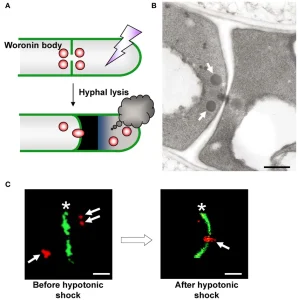
However, this interconnected system also presents a vulnerability: cellular damage in one compartment can lead to cytoplasmic leakage throughout the hyphal network. To counteract this risk, filamentous fungi have evolved a specialized organelle known as the Woronin body (WB).
What Are Woronin Bodies?
Woronin bodies are peroxisome-derived organelles unique to filamentous fungi. Their primary function is to rapidly seal septal pores in response to cellular injury, preventing the loss of cytoplasm and maintaining cellular integrity.
At the molecular level, Woronin bodies are built around a core protein called HEX (Hexagonal peroxisomal protein). This protein:
- Contains a Peroxisomal Targeting Signal 1 (PTS1)
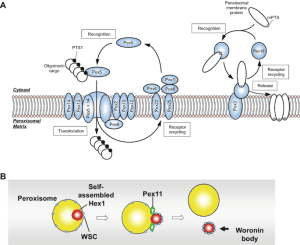
- Is imported into the peroxisomal matrix
- Self-assembles into a dense, crystalline structure
This assembly forms the physical plug that blocks septal pores upon damage.
Biological Importance
Functional Woronin bodies are essential for fungal survival and pathogenicity. Mutations affecting HEX lead to:
- Cytoplasmic leakage after injury
- Impaired hyphal integrity
- Reduced invasive growth in plant pathogens such as Magnaporthe grisea
This highlights the adaptive significance of Woronin bodies in maintaining fungal architecture and virulence.
Mechanism of Woronin Body Biogenesis
De Novo Formation from Peroxisomes
Woronin bodies originate from peroxisomes through a highly regulated differentiation process. Their formation involves several coordinated steps:
- HEX Protein Expression and Assembly
HEX is predominantly expressed in apical (growing) hyphal regions, where it begins to self-assemble within the peroxisomal matrix. - Association with Peroxisomal Membrane
HEX assemblies attach to the inner surface of the peroxisomal membrane. - Budding of Nascent Woronin Bodies
These HEX-containing structures bud off, forming immature Woronin bodies. - Cortical Anchoring and Septal Localization
Mature Woronin bodies migrate and anchor near septa, ensuring rapid response to cellular damage.
Despite this well-described sequence, the molecular regulators orchestrating these steps were long unclear.
Discovery of the Woronin Sorting Complex (WSC)
Identification Through Genetic Screening
A forward genetic screen in Neurospora crassa identified mutants defective in Woronin body formation. Among these, a key gene named wsc (Woronin Sorting Complex) was discovered.
Functional Role of WSC
WSC encodes a membrane protein related to the PMP22/MPV17 family, and it plays a dual role in:
- Morphogenesis of Woronin bodies
- Inheritance and spatial distribution within hyphae
WSC in Woronin Body Morphogenesis
Interaction with HEX Assemblies
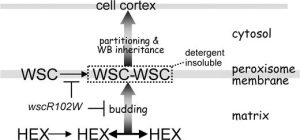
WSC is essential for linking HEX assemblies to the peroxisomal membrane. In normal cells:
- WSC localizes to large peroxisomes containing HEX
- It envelops HEX assemblies, forming a specialized membrane domain
- This leads to the generation of asymmetrical nascent Woronin bodies
In contrast, wsc mutants show major defects:
- HEX assemblies fail to attach to the membrane
- They move randomly within the peroxisomal matrix
- Woronin bodies fail to form properly
Role of WSC in Organelle Inheritance
Beyond formation, WSC also controls the segregation of Woronin bodies:
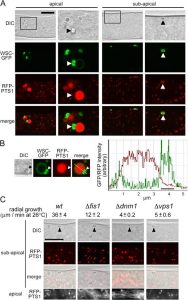
- In wild-type cells, Woronin bodies are distributed across both apical and subapical compartments
- In wsc mutants, they accumulate excessively in the apical region
- This indicates a failure in cortical association and organelle inheritance
Importantly, this defect is specific to Woronin bodies, as other organelles (e.g., nuclei) remain normally distributed.
Molecular Properties of WSC
Membrane Association and Stability
WSC exhibits unique biochemical properties:
- Forms detergent-resistant complexes
- Remains associated with Woronin bodies even after membrane disruption
- Likely assembles into oligomeric protein structures
Dependence on HEX
The behavior of WSC is strongly influenced by HEX:
- Without HEX, WSC distributes across small peroxisomes
- It loses its specialized localization and structural stability
- Large Woronin body-forming peroxisomes fail to develop
This demonstrates that HEX controls peroxisomal differentiation and WSC targeting.
WSC Self-Assembly and Protein Interactions
Experimental evidence shows that WSC:
- Can self-assemble into oligomers independently of HEX
- Forms dense membrane domains
- Interacts physically with HEX to stabilize Woronin body formation
Mutations disrupting these interactions lead to:
- Defective organelle formation
- Impaired fungal growth
- Loss of stress response capability
Link to Human Disease: MPV17 Homologs
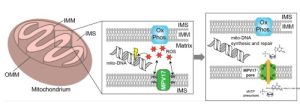
Interestingly, WSC is homologous to the mitochondrial protein MPV17, which is associated with mitochondrial DNA depletion syndrome (MDDS) in humans.
Mutations analogous to human disease variants:
- Disrupt WSC function
- Impair protein complex formation
- Block proper Woronin body development
This suggests a conserved mechanism of membrane protein assembly across species.
Integration of Morphogenesis and Organelle Segregation
Woronin body formation illustrates a broader biological principle:
Organelle biogenesis and inheritance are tightly coordinated processes
In filamentous fungi:
- HEX drives internal matrix assembly
- WSC controls membrane remodeling and positioning
- Together, they ensure functional specialization and correct localization
This coordination allows peroxisomes to generate distinct, functionally specialized organelles.
Conclusion
Woronin body biogenesis represents a highly specialized adaptation in filamentous fungi, integrating peroxisomal protein sorting, membrane dynamics, and cytoskeletal interactions. The discovery of the Woronin Sorting Complex (WSC) provides critical insight into:
- How peroxisomes generate new organelles
- How protein self-assembly drives cellular architecture
- How organelle inheritance is regulated
Understanding these mechanisms not only advances fungal cell biology but also offers broader implications for organelle biogenesis, intracellular trafficking, and human mitochondrial diseases.