
Introduction
Peroxisomes are essential, single-membrane-bound organelles present in virtually all eukaryotic cells. They host a wide range of metabolic enzymes over 50 identified to date responsible for critical biochemical processes such as fatty acid β-oxidation, lipid biosynthesis, and reactive oxygen species detoxification. These organelles are indispensable for maintaining cellular homeostasis, particularly in tissues with high metabolic activity such as the liver and brain.
Disruptions in peroxisome formation or function lead to a group of severe inherited conditions collectively known as peroxisome biogenesis disorders (PBDs). These diseases, including Zellweger syndrome and neonatal adrenoleukodystrophy (NALD), are typically autosomal recessive and often fatal early in life. At the molecular level, PBDs arise from mutations in genes encoding peroxins (PEX proteins) a family of proteins required for peroxisome assembly, maintenance, and protein import.
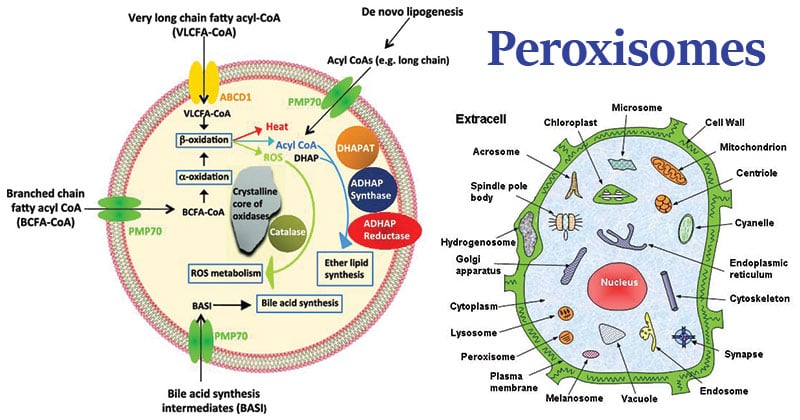
PEX Genes and the Discovery of PEX26
To date, multiple complementation groups (CGs) have been identified in PBD patients, each corresponding to mutations in specific PEX genes. While most PEX genes had been characterized, one group CG8 (also known as CG-A) remained unresolved for years.
The identification of PEX26 marked a major breakthrough in this field. Using a functional complementation approach involving mutant Chinese hamster ovary (CHO) cells lacking proper peroxisome biogenesis, researchers isolated a previously unknown gene encoding a protein of approximately 305 amino acids (≈34 kDa), now termed Pex26p.
Expression of this gene in defective cells restored normal peroxisomal function, firmly establishing PEX26 as the missing pathogenic gene associated with CG8.
Structural Features and Novelty of Pex26p
Bioinformatic and biochemical analyses revealed that Pex26p represents a distinct class of peroxin. Unlike previously characterized PEX proteins:
- It shows low sequence homology (15–19%) to known yeast peroxins
- It possesses a hydrophilic N-terminal region and a hydrophobic C-terminal segment, suggesting membrane association
- It behaves as a type II integral membrane protein, anchored in the peroxisomal membrane
Importantly, this low similarity indicates that Pex26p is not simply a conserved ortholog but rather a functionally specialized peroxin with unique structural properties.
Subcellular Localization and Membrane Topology

Advanced imaging and biochemical fractionation experiments demonstrated that Pex26p localizes specifically to peroxisomes. When tagged with fluorescent or epitope markers:
- It appears as punctate structures, characteristic of peroxisomes
- It co-localizes with known peroxisomal markers such as catalase and membrane proteins
Topology studies further revealed a dual-orientation structure:
- The N-terminal domain faces the cytosol
- The C-terminal region is oriented toward the peroxisomal matrix
This orientation is critical for its interaction with cytosolic protein complexes while maintaining anchorage within the membrane.
Functional Role: Recruitment of AAA ATPase Complexes
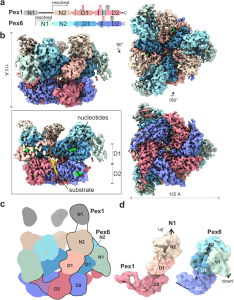
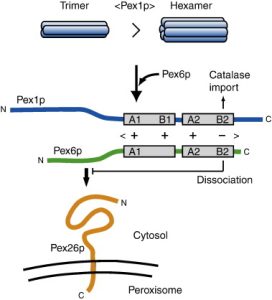
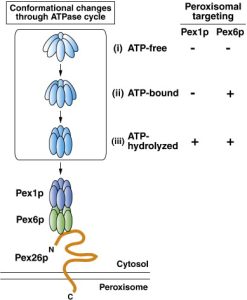
One of the most significant discoveries regarding Pex26p is its role in recruiting the Pex1p–Pex6p complex, members of the AAA (ATPases Associated with diverse cellular Activities) protein family.
These ATPases are essential for peroxisomal protein import and recycling mechanisms. Experimental evidence shows that:
- Pex26p directly binds to Pex6p
- Pex1p associates indirectly via Pex6p
- Together, they form a functional heteromeric complex at the peroxisomal membrane
In cells lacking functional PEX26:
- Pex1p and Pex6p fail to localize to peroxisomes
- Protein import into peroxisomes is severely impaired
Thus, Pex26p acts as a membrane anchor or docking platform, ensuring proper localization and function of these ATPase complexes.
Pathogenic Mutation: The Case of Arg98Trp (R98W)
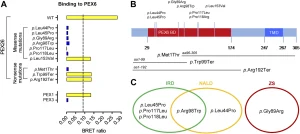
A critical insight into PEX26 function comes from the identification of a disease-causing mutation: Arginine 98 to Tryptophan (R98W).
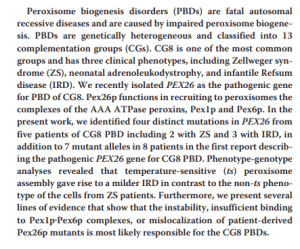
This mutation:
- Occurs in a homozygous state in affected individuals
- Leads to loss of functional Pex26p activity
- Results in failure to restore peroxisome formation in mutant cells
Mechanistically, the R98W mutation appears to:
- Reduce protein stability
- Impair interaction with Pex6p
- Disrupt recruitment of the Pex1–Pex6 complex
Ultimately, this leads to defective peroxisome biogenesis, explaining the severe clinical phenotype observed in CG8-associated PBD patients.
Molecular Interactions and Mechanistic Insights
Co-immunoprecipitation and pull-down assays have provided strong evidence for the interaction network involving Pex26p:
- Direct interaction: Pex26p ↔ Pex6p
- Indirect interaction: Pex26p ↔ Pex1p (via Pex6p)
This suggests a hierarchical assembly model:
- Pex26p anchors into the peroxisomal membrane
- Pex6p binds directly to Pex26p
- Pex1p is recruited through Pex6p
- The resulting complex facilitates ATP-dependent processes
These processes likely include:
- Recycling of peroxisomal import receptors (Pex5, Pex7)
- Regulation of protein translocation into the peroxisomal matrix
Functional Analogy with Vesicular Transport Systems
Interestingly, the role of Pex26p shows conceptual similarities to vesicular trafficking systems:
- It resembles how SNARE proteins recruit NSF ATPases in membrane fusion
- However, Pex26p lacks canonical SNARE motifs
This suggests that Pex26p may function as a SNARE-like protein, participating in membrane-associated protein complex assembly without belonging to the classical SNARE family.
Implications for Peroxisome Biogenesis and Disease
The discovery and characterization of Pex26p provide critical insights into:
- The mechanisms of peroxisomal membrane assembly
- The ATP-dependent machinery driving protein import
- The molecular basis of specific PBDs
From a clinical perspective:
- PEX26 mutations complete the catalog of known genes responsible for all major PBD complementation groups
- Understanding its function opens avenues for diagnostic and therapeutic strategies
Conclusion
Pex26p is a central regulatory component of peroxisome biogenesis, acting as a membrane anchor that recruits and organizes essential AAA ATPase complexes. Its unique structural features, combined with its pivotal role in protein import and organelle assembly, make it a critical factor in cellular metabolism and human disease.
The identification of PEX26 not only resolved a long-standing gap in peroxisome biology but also highlighted the intricate coordination between membrane proteins and cytosolic machinery required for organelle function. Continued research into Pex26p and its interacting partners will further deepen our understanding of peroxisomal dynamics and may contribute to the development of targeted therapies for peroxisomal disorders.