
Introduction to Peroxisomes in Fungal Biology
Peroxisomes are dynamic, single-membrane-bound organelles present in all eukaryotic cells. They play a central role in a wide range of metabolic processes, including fatty acid β-oxidation, the glyoxylate cycle, cholesterol metabolism, and methanol assimilation. In filamentous fungi, peroxisomes extend beyond basic metabolism and are critically involved in processes such as sexual development, secondary metabolite biosynthesis, and host-pathogen interactions.
In phytopathogenic fungi such as Colletotrichum orbiculare and Magnaporthe oryzae, peroxisomes are indispensable for successful infection. These fungi develop specialized infection structures known as appressoria, which generate mechanical force to penetrate host plant tissues. The functionality of appressoria depends heavily on peroxisomal metabolism, particularly lipid mobilization and energy production.
Role of Peroxisomes in Appressorium-Mediated Infection
During appressorium development, intracellular lipid droplets are mobilized and degraded through lipolysis. This process releases fatty acids that undergo β-oxidation within peroxisomes, leading to the production of acetyl-CoA. This metabolite is crucial for:
- Energy generation
- Turgor pressure buildup (essential for host penetration)
- Biosynthesis of melanin (specifically DHN-melanin), which strengthens the appressorial cell wall
Disruption of these metabolic pathways significantly impairs fungal pathogenicity, highlighting the essential role of peroxisomes in infection biology.
Peroxisome Biogenesis and the Role of Peroxins
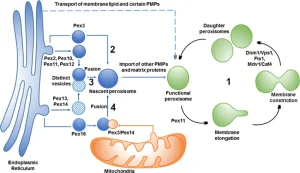
The life cycle of peroxisomes involves several tightly regulated steps:
- Membrane formation and protein sorting
- Import of matrix proteins from the cytosol
- Organelle division
- Selective degradation via pexophagy, a specialized form of autophagy
These processes are controlled by a group of proteins known as peroxins (PEX proteins). To date, over 30 peroxins have been identified.
Key components include:
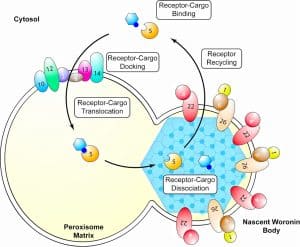
- Pex5 and Pex7: receptors for peroxisomal targeting signals (PTS1 and PTS2)
- Pex13 and Pex14: docking proteins at the peroxisomal membrane
- Pex4, Pex22, Pex1, and Pex6: involved in receptor recycling through ubiquitination and ATP-dependent processes
Efficient recycling of PTS receptors is essential for continuous import of proteins into peroxisomes.
Woronin Bodies: Specialized Peroxisome-Derived Organelles
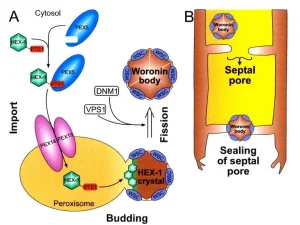
Woronin bodies (WBs) are unique organelles found exclusively in filamentous ascomycete fungi. They originate from peroxisomes and function primarily to maintain cellular integrity by sealing septal pores following hyphal damage.
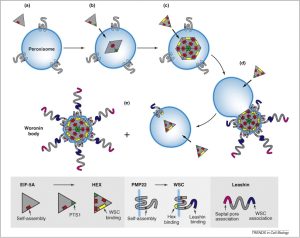
Features of Woronin bodies:
- Derived from peroxisomes
- Contain a dense protein core mainly composed of HEX1
- Prevent cytoplasmic leakage after cellular injury
- Localize near septa and hyphal tips
WB formation involves a coordinated process:
- Import and self-assembly of HEX1 in the peroxisomal matrix
- Recruitment of Woronin body sorting complex (WSC) proteins
- Membrane budding and organelle maturation
- Final separation mediated by tethering proteins such as LAH-1
Despite their origin, only limited evidence previously linked peroxins directly to WB biogenesis.
Discovery of FAM1
Using insertional mutagenesis, researchers identified a gene named FAM1 (Fatty Acid Metabolism 1) in Colletotrichum orbiculare. This gene is unique to filamentous ascomycetes and plays a critical role in:
- Fatty acid utilization
- Peroxisome biogenesis
- Infection-related morphogenesis
- Fungal pathogenicity
Sequence analysis revealed that FAM1 encodes a protein structurally similar to Pex22, a membrane anchor for the ubiquitin-conjugating enzyme Pex4.
Although sequence similarity with yeast Pex22 is low, functional assays demonstrated that FAM1 acts as a functional ortholog of PEX22.
Functional Validation of FAM1
Yeast Complementation Assay
To confirm its function, FAM1 was expressed in a Saccharomyces cerevisiae pex22 mutant:
- FAM1 alone partially restored peroxisomal protein import
- Co-expression with fungal PEX4 fully restored function
This demonstrates that FAM1 is involved in PTS receptor recycling, a hallmark function of Pex22.
FAM1 Is Essential for Peroxisome Function and Fungal Infection
Deletion of FAM1 resulted in multiple defects:
Metabolic defects
- Inability to grow on fatty acid substrates
- Impaired lipid mobilization
Cellular defects
- Failure to import peroxisomal matrix proteins
- Disrupted peroxisome biogenesis
Morphological defects
- Abnormal, non-melanized appressoria
- Reduced size and altered structure
Pathogenicity defects
- Complete loss of infection ability on intact plant tissues
- Failure to penetrate host cells
These findings confirm that FAM1 is critical for fungal virulence.
Unexpected Localization of FAM1 to Woronin Bodies
Contrary to expectations, FAM1 was not primarily localized on peroxisomes. Instead, advanced imaging techniques revealed:
- Predominant localization on Woronin body membranes
- Partial and asymmetric association with peroxisomes
- Enrichment near hyphal tips and septa
Colocalization studies with WB markers (HEX1 and WSC) confirmed that FAM1 is a Woronin body-associated protein.
Role of FAM1 in Woronin Body Biogenesis
Functional studies demonstrated that:
- FAM1 is required for proper WB formation
- In FAM1 mutants, WB structure and localization are disrupted
- HEX1 distribution becomes diffuse in the absence of FAM1
Ultrastructural analysis using immunoelectron microscopy showed:
- FAM1 localizes to WB membranes
- HEX1 localizes to the WB core
This indicates a functional division within WBs, where structural and regulatory proteins occupy distinct regions.
Dynamic Localization Depends on HEX1
In mutants lacking HEX1:
- Woronin bodies fail to form
- FAM1 is redirected to peroxisomal membranes
This suggests that:
- HEX1 is necessary for recruiting or stabilizing FAM1 in WBs
- FAM1 initially targets peroxisomes and is later relocalized
Woronin Bodies Are Not Essential for Pathogenicity
Interestingly, deletion of HEX1 showed that:
- Woronin bodies are not required for infection
- Appressorium formation and host penetration remain intact
- Pathogenicity is unaffected
This contrasts with other fungi, where WBs contribute to virulence.
Biological Significance and New Model
This study reveals a novel biological concept:A peroxin (FAM1) involved in peroxisome biogenesis is predominantly localized in a derived organelle (Woronin body).
Proposed functional implications:
- Partial compartmentalization of receptor recycling
- Spatial separation of protein import and receptor release
- Possible regulatory role of WBs in peroxisome function
Conclusion and Future Perspectives
FAM1 represents a previously unknown class of peroxin unique to filamentous fungi. Its dual role in:
- Peroxisome biogenesis
- Woronin body association
makes it a key regulator of fungal development and pathogenicity.
Future research should focus on:
- Identifying additional WB-associated peroxins
- Understanding the mechanistic link between peroxisomes and WBs
- Exploring how protein trafficking is spatially regulated in fungal cells
Understanding these processes could provide new targets for controlling fungal plant pathogens and improving crop protection strategies.